
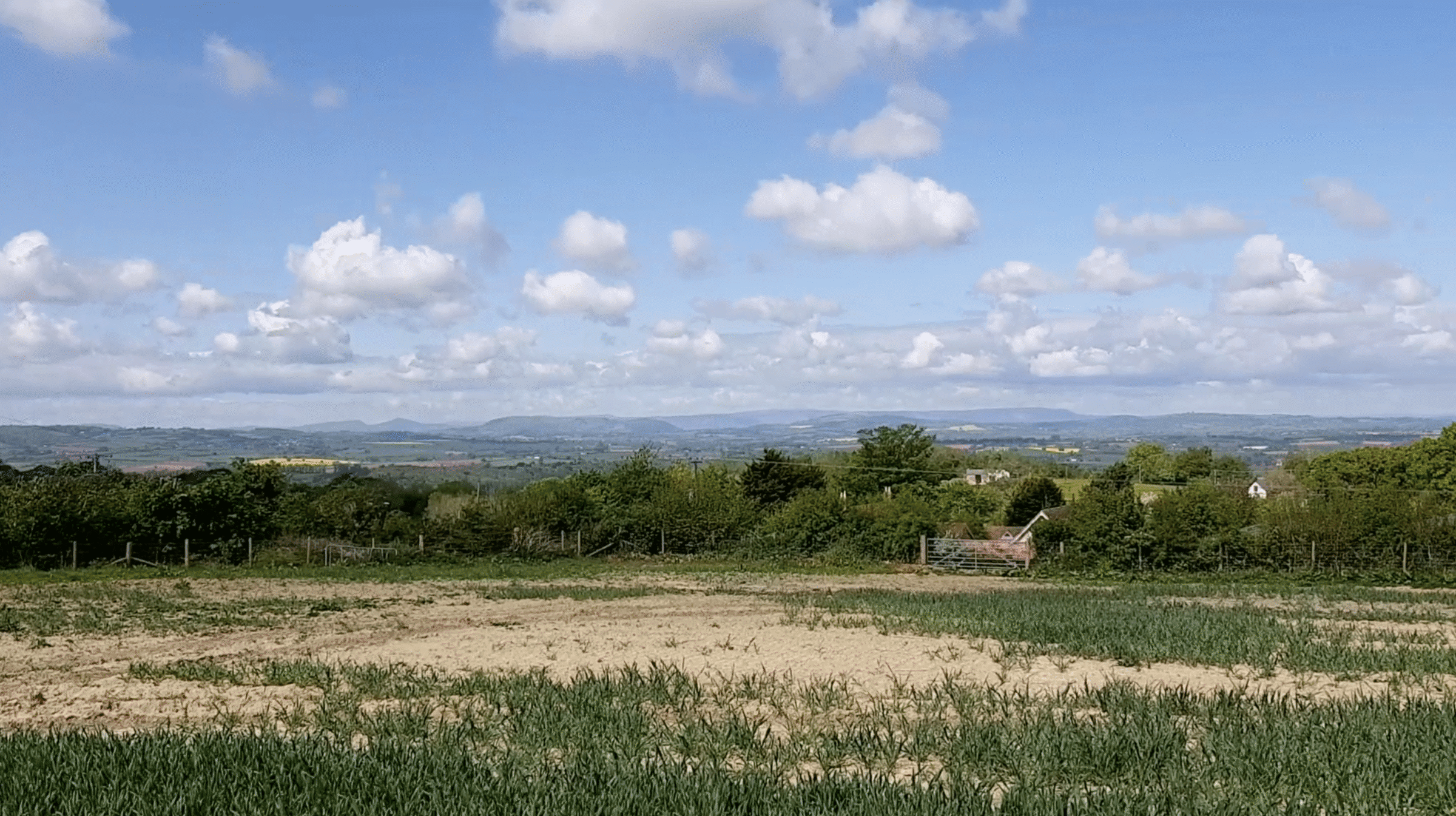
Some projects announce themselves quietly. There is no dramatic brief, no glossy site appraisal, no clear path forward from the first conversation. Longview was one of those projects. What it had instead was a field, a view, and a pair of clients who had spent years quietly working out what they wanted from the next chapter of their lives.
I first met the clients at their home at Little Howle Farm, a working farm and holiday cottage complex on Howle Hill, a few miles outside Ross-on-Wye in south Herefordshire. They had lived there for several years, having moved to the county from Switzerland, and in that time they had renovated the old farmhouse, converted a granary, and created two stone barn dwellings that now operated successfully as holiday lets. They were methodical, thoughtful people — one with a background in research and development, the other in horticulture and landscape — and they had reached a point where the farm’s working life no longer matched where they were heading. Running three holiday cottages alongside a family home is a demanding business. Retirement, or something approaching it, required a different kind of property.
What they wanted was deceptively simple: a contemporary, highly sustainable new house that they could design from scratch and live in for the long term. Something that represented the way they believed houses should be built, not the compromises that older stock always involves. They had looked, and nothing like it existed in Howle Hill. The choice, as they put it, was either to build it or to leave. They had no intention of leaving.
The Moment of Clarity
The site presented itself during a walk through a ten-acre field they owned — a partially enclosed arable field sitting above and to the east of the farm, known locally as “Top of the Pitch.” I have visited a great many sites over my career as a Herefordshire architect, and what struck me about this one was immediate and instinctive. From certain positions within the field, the view opens in a way that feels almost theatrical. To the north and northwest, the Welsh Mountains sit on the horizon. The Brecon Beacons rise beyond them, forty kilometres away. Chase Woods define the middle distance. Further east, the Malvern Hills close the panorama. It is the kind of view that makes you stand still.
The field is isolated. There is no question about that. It sits outside the defined settlement boundary of Howle Hill, in what Herefordshire’s planning framework classifies as open countryside. Under normal planning policy, that status closes the door to residential development firmly and without apology. My practice, Thomas Studio, has been working with Paragraph 84 of the National Planning Policy Framework — the policy route that allows for exceptional quality isolated dwellings in the countryside — for a number of years, and I recognised immediately that this was the only viable path. I also recognised that the field, the clients, and the combination of their ambitions represented exactly the kind of project that Paragraph 84 exists to produce.
What Paragraph 84 Actually Requires
It is worth being clear about what Paragraph 84(e) of the NPPF demands, because there is a common misconception that it provides an easy route to a house in a field. It does not. The policy permits isolated homes in the open countryside only where the design is of exceptional quality — meaning it must be truly outstanding, reflecting the highest standards in architecture, and must help to raise standards of design more generally in rural areas. Beyond that, it must significantly enhance its immediate setting and be sensitive to the defining characteristics of the local area.
Every word of that test matters. Truly outstanding is not the same as attractive, or well-designed, or carefully considered. It sets a standard that demands a rigorous, iterative, landscape-driven design process — one that cannot be rushed, cannot be manufactured, and cannot begin from a predetermined aesthetic. You have to earn the right to build in the open countryside, and the earning of it is the process.
The clients understood this from the outset, which is one of the reasons I was confident the project could succeed. They were not looking for a shortcut. They were prepared for what Herefordshire’s planning framework would require of them: multiple pre-application stages, an independent landscape assessment, a design review panel, community consultation, and a submission of considerable depth and evidence. They approached it in the same way they had approached everything else in their professional lives — methodically, with curiosity, and with a genuine desire to do it properly.
Why This Site
Not every isolated field qualifies as a candidate for Paragraph 84(e), and it would be misleading to suggest otherwise. What distinguishes a strong candidate from a weak one is rarely about the view, although the view from Top of the Pitch is exceptional. It is about whether the land, the landscape character, and the specific qualities of the location can generate a design response that is genuinely rooted in place — one that could only exist here, on this hillside, in this particular corner of south Herefordshire.
Howle Hill has a layered history. The surrounding landscape bears the marks of historical quarrying, which produced a distinctive settlement character: workers’ cottages set into quarry cuttings for shelter, facing northwest, typically 20 by 6 metres in footprint, surrounded by native trees. To the east of the field sits Great Howle Camp, a Scheduled Ancient Monument — a Norman hill fort associated with Goodrich Castle, now little more than an earthwork colonised by self-set trees, but in its day a prominent lookout post commanding long views across the landscape. These are the defining characteristics of the local area. They are also, as it turned out, the seeds of everything that became Longview.
Starting the Conversation with Herefordshire Council
Before any design work could meaningfully begin, there was a prior question that needed answering: would the council confirm that the site was classified as isolated? Isolation is not always straightforward to establish, and it has been a point of contention in a number of Paragraph 84 cases nationally. The definition is not purely about distance from a settlement; it concerns the relationship between the proposed dwelling and the nearest group of buildings, and different authorities have interpreted it differently.
In February 2020, I submitted the first pre-application enquiry to Herefordshire Council on behalf of the clients. Its purpose was narrow and specific: to establish the isolation question definitively before any significant design investment was made. The council’s response was clear and unambiguous. The field was isolated. The site qualified. The path was open.
What struck me in the council’s pre-application response was the quality of the guidance it contained beyond that confirmation. Officers were direct about the nature of Paragraph 84 — that it is not a permissive policy, not a backdoor route, and not a guaranteed outcome for any applicant regardless of resources or ambition. But they were also constructive: they pointed us towards successful precedent projects within Herefordshire, outlined the landscape-led process they would expect to see, and signalled that an independent design review would be an important part of demonstrating the quality of the proposals. This was not a planning authority looking for reasons to refuse. It was one looking for a reason to say yes, provided the evidence was there to support it.
That is the kind of engagement that makes exceptional projects possible. And it set the tone for everything that followed.
Longview is a Paragraph 84(e) exceptional rural dwelling designed by Thomas Studio for private clients in Howle Hill, Herefordshire. The project received planning permission from Herefordshire Council in July 2023 and is currently under construction. If you are considering a self-build or exceptional rural dwelling and would like to discuss whether your site might qualify, contact Garry Thomas at Thomas Studio.
Further posts in this series document the full design and planning journey from landscape analysis through to permission granted.